Safety Tips: How to Avoid Scams and Fraud in Job and Service Ads
Last updated: November 2026 · By the BusineSooq team
BusineSooq is an open classifieds platform that connects job seekers with employers, and customers with service providers. Any open platform attracts people who try to abuse it. This guide covers every type of scam and fraud you may meet in job and service ads: how to spot it from the first message, how to verify before you pay or share data, and what to do and where to report if it happens to you. Read the part that applies to you, whether you are looking for a job, hiring a technician or a service, or advertising your own service or vacancy.
6 rules that stop most scams
- Never pay in advance to someone you do not know: no recruitment fee, no deposit to a technician you have not met, no "account top-up".
- Never share a one-time code (OTP), PIN or bank card details with anyone. Receiving money needs none of them.
- Never open a payment or "receive your transfer" link sent by an advertiser or a customer.
- Never receive someone else's money in your account or wallet to pass it on.
- Verify first: a company with an office and registration, or a technician with a name, reviews and previous work.
- Put every agreement in writing in the chat: price, scope, date and payment method.
In this guide
- How a scam works
- 10 general warning signs of a suspicious ad
- For job seekers: job ad scams
- For customers: scams when hiring a service or technician
- For service providers and advertisers
- Messages impersonating BusineSooq
- Verify the other party in 10 minutes
- What to share and what to keep private
- Safe interviews and safe home visits
- Jobs abroad and work visas
- Been scammed? Do this now
- How to report a suspicious ad or user
- FAQ
How a scam works
A fake job, a fake technician and a fake customer differ in the details, but the script is the same and has four stages:
- The bait: an offer better than the market: high pay with no experience, a service price below everyone else, or a customer ready to pay immediately without questions.
- Building trust: a well-known company name, a logo, photos of work, a PDF "contract", or a screenshot of a bank transfer.
- The ask: a small advance payment, or sensitive data (ID photo, verification code, card details).
- Escalation, then silence: bigger amounts "to release what you paid", then your number is blocked and the chat deleted.
This is the pattern the Central Bank of Egypt warned about in October 2026 as part of its anti-fraud campaign: messages offering fake jobs with high pay that begin with a small transfer and grow into larger ones. The same month, Dubai Police warned about fake job offers, and it had earlier warned about fake recruitment offices on social media that ask for a "deposit" and "delivery fees" in instalments.
10 general warning signs of a suspicious ad
These apply to a job ad, a service ad, and anyone who contacts you because of your own ad:
- They ask for money before delivering anything. Fees, deposit, insurance, transport costs or "activation".
- They ask for a verification code or card details. No honest transaction needs your OTP, PIN or the three digits on the back of your card.
- They send a link to pay, to "receive the amount" or to "confirm your account".
- The offer is too good to be true: unrealistic pay, or a price far below every competitor.
- They rush and pressure you: "today only", "one place left", "transfer now".
- They insist on leaving the platform for WhatsApp or Telegram from the first message, from a foreign number or a new account.
- They avoid proving who they are: no full name, no address, no commercial registration, and they refuse a call or a meeting.
- A vague or copied ad: stock photos, generic wording, and the same ad repeated across many cities with different numbers.
- They impersonate a known name: a ministry, a large company, an "authorised agent", or "BusineSooq customer service".
- They ask for secrecy or get annoyed when you say you will ask someone or check first.
For job seekers: job ad scams
The rule is simple: a real job pays you; it does not charge you. Recruitment, training and uniform costs are the employer's responsibility. The most common tricks:
| Scam | How it starts | What they ask for |
|---|---|---|
| Recruitment fees | An ad for an ordinary job (security, driver, warehouse, customer service) and instant acceptance with no interview | A file, medical, uniform or deposit fee before you start |
| Like-and-review tasks | A WhatsApp or Telegram message: "work one hour a day from your phone" | After small real payouts: a deposit to unlock "VIP tasks" |
| Fake overseas contracts and visas | "A work contract in the Gulf or Europe" from a broker or unlicensed office | An advance for the visa and ticket, then silence or a forged contract |
| Impersonation | A page or site imitating a known employer or ministry announcing "vacancies" | An application fee, or your full data and ID photo |
| Money mule | A work-from-home role as "collections agent" or "payments officer" | Receiving transfers in your account and sending them on. You become the suspect for the bank and the law |
| Data theft | An "application form" link or an app you must install | Login details, a verification code, or access to your phone |
| Pyramid schemes and "investment" | A "job opportunity" that turns into a product pitch or trading platform at the interview | Buying a package or depositing capital, and bringing in people you know |
| Unpaid "trial" work | A long "test" or an unpaid trial week | Real, complete work (translation, design, sales), then no reply |
Watch for the small-amount trick: the scammer knows you will not send EGP 5,000 to a stranger, so they start with 150 or 200. People who pay a little tend to pay more "so the first payment is not wasted". Stop at the first request.
For customers: scams when hiring a service or technician
When you look for a plumber, an electrician, an AC technician, a tutor or a moving company, the risk is not only in the ad but in what happens after you agree. The most common cases:
| Scam | How it happens | How to avoid it |
|---|---|---|
| Deposit, then gone | They ask for an advance transfer "to book the slot" or for "transport" before showing up | Pay nothing before arrival and inspection. Pay once work starts or is finished |
| Bait pricing | A very low price in the ad that doubles once the appliance is opened or work begins | Get a written quote in the chat covering labour and materials before work starts |
| Invented faults | They "discover" serious extra faults, or damage a working part to replace it | Be present, ask to see the faulty part, and get a second opinion on big repairs |
| Fake or used parts | You are charged for an original part and get a copy, or they keep your working old part | Ask for the part's invoice and box, and keep the old part |
| Fake "authorised agent" | They claim to be the official service centre of a known brand | Take the service number from the brand's website or warranty card, not from the ad |
| Materials advance | They take a large sum to buy materials and do not return, or leave the job half done | Buy materials yourself or with them, and pay in stages for work actually done |
| Theft during the visit | A person of unknown identity enters your home "to inspect" | Ask for a full name and ID photo before the visit, and do not leave them alone at home |
A safe agreement with any service provider
- Compare two or three quotes. A price far below the rest is a sign, not a bargain.
- Open the advertiser's profile: check reviews, other ads and how long they have been on the platform, and ask for photos of previous work.
- Write the agreement in the chat: exactly what is to be done, what the price includes, the timeline and the warranty.
- For big jobs (finishing, furniture moving, full maintenance) pay in stages and get a receipt for each payment.
- Do not pay the balance before you have tested the result yourself.
More detail: 7 Warning Signs You're Hiring the Wrong Technician and How to Choose the Right Professional for Your Project.
For service providers and advertisers: beware the fake customer
Advertisers are targets too. Once your number is public in a service or job ad, you may receive these attempts:
- Fake transfer receipt: "I have sent you the money", with a screenshot or an SMS that looks like the bank's. Do not start work or hand anything over until you see the amount in your balance inside the banking or wallet app itself.
- Overpayment: "I sent too much by mistake, refund the difference". The original transfer is fake or will be reversed, and what you send back is your own money.
- "Receive your payment" link: a link asking for your card details or a verification code "so the transfer reaches you". Receiving money needs only an account or wallet number.
- "A code reached you by mistake": they ask for a code sent to your phone. It is the login code for your account, wallet or WhatsApp.
- The big urgent order: a customer in another city wants a large job and needs you to pay first a "supplier registration fee", an "insurance" or a shipment cost.
- Luring you somewhere remote: an inspection in an isolated place or late at night, insisting you come alone with your equipment.
- For employers: a "CV" sent as a link or an executable file instead of a PDF, or an applicant asking for your login to some platform "to complete the application".
- Fake promotion offers: someone offering to "feature your ad" or "verify your account" for a transfer to their personal number.
The advertiser's rule: money that is not in your balance has not arrived. No screenshot or SMS replaces opening the banking app yourself.
Messages impersonating BusineSooq
You may get a message or call from someone claiming to be "BusineSooq management" or "customer service". Remember:
- We will never ask for your verification code, password or card details by chat, phone or WhatsApp.
- Any paid package or service is bought only inside the website or app, from the packages page, never by transfer to a personal number or account.
- Account verification is done from inside your own account, not by an intermediary for a fee.
- Check that the address in your browser is businesooq.com before entering your login, and do not sign in through a link you received in a message.
Received a message like this? Do not reply, and send us a screenshot through the Contact us page.
Verify the other party in 10 minutes
- Search the name and phone number with the words "scam", "complaints" or "reviews".
- Open the advertiser's profile on the platform: how long have they been advertising, what else do they post, do they have reviews, is the account verified?
- Ask for official details: for a company, the trade name, registration number and office address; for a technician, the full name, working area and photos of previous work.
- Check the channels: an official website, a company-domain email and a page with history, not one created last week.
- Call the organisation on its official number from its own website and ask: is this vacancy, branch or representative yours?
- Ask for a voice or video call or a meeting at the office. Repeated refusal is a sign in itself.
- Get the offer in writing: for a job, the title, duties and salary; for a service, the price, what it includes, the timeline and the warranty.
- Compare with the market and ask someone you trust. Scammers ask for secrecy; a second opinion sees what excitement hides.
What to share and what to keep private
| Situation | Fine to share | Do not share |
|---|---|---|
| Applying for a job | CV, name, phone, email, city | ID photo, full home address, any banking data |
| After a written offer and interview | Copies of your ID and certificates for HR | Your original ID, passport or certificates |
| Hiring a service or technician | A description and photos of the problem, and your area. Full address only after you agree | When the home is empty, photos that reveal valuables, your key to a stranger |
| Receiving a fee or salary | Account number, IBAN or wallet number only | Full card number, expiry date, the three-digit CVV |
| At any time | Nothing more | OTP, PIN, the password of your wallet, banking app or platform account |
If you must send a copy of your ID, write the purpose, the organisation's name and the date clearly across it so it is harder to reuse. Never sign a blank paper or a trust receipt under any label.
Safe interviews and safe home visits
Job interviews
- At a company office with a sign, a reception and staff, during working hours. Not in a flat or an isolated place.
- Tell a family member the address, the time and the name of the person you are meeting, and share your location.
- Do not get into a "company representative's" car, pay nothing, and leave no original documents.
- If the conversation turns to buying products, paying a subscription or recruiting others, excuse yourself and leave.
Having a technician in your home
- Know their full name and number before they arrive, and check that the person who shows up is the one you agreed with.
- Avoid being alone at home if you can, and keep valuables away from the work area.
- Stay present during the work, and do not let an appliance be taken "to the workshop" without a receipt showing their name, number and the appliance details.
Going to a customer (for service providers)
- Ask for the full address and the customer's name, and tell someone where you are going.
- Decline late-night jobs in isolated places for a customer you do not know.
- Agree on the fee and payment method before you set off, and write it in the chat.
Jobs abroad and work visas
This type costs victims the most, because the amounts are large and the person may actually travel on a worthless contract.
- From Egypt: the Ministry of Labour is the authority that regulates overseas employment. It warns against brokers, unlicensed offices and pages that impersonate it. Ask the ministry whether the recruitment company is licensed before you deal with it, and have the contract reviewed there before you travel.
- To Saudi Arabia: a genuine employment contract is documented electronically on the Qiwa platform of the Ministry of Human Resources, and you receive a notification to review and accept it yourself. A contract that never appears there deserves questions.
- To the UAE: official guidance states that the worker does not bear recruitment and visa costs, and that the job offer is issued through the Ministry of Human Resources and Emiratisation. A tourist or visit visa does not allow you to work.
- In every case: do not pay an individual broker, do not transfer to a personal wallet, and do not travel before confirming the contract and visa through official channels.
Been scammed? Do this now
Speed matters most. Every hour of delay lowers the chance of stopping the transfer.
- Stop paying completely. There is no "final payment" that releases your money.
- Call your bank or wallet provider now on the number printed on your card and ask them to stop the transaction and block the card.
- Change your passwords for banking, email, wallet and your platform account, especially if you opened a link or gave out a code.
- Keep the evidence: screenshots of chats and the ad, phone numbers, account and wallet numbers, transfer receipts. Do not delete the conversation.
- File an official report in your country (table below).
- Report it to the platform so the ad or account is removed before someone else falls for it.
- Beware the second scam: anyone who contacts you afterwards promising to recover your money for a fee is another scammer, or the same one.
| Country | Where to report |
|---|---|
| Egypt | The cybercrime police hotline 108, the "report a cybercrime" e-service on the Ministry of Interior website, or the nearest police station. Your bank first if money was transferred. |
| Saudi Arabia | Your bank immediately, then a report through the Kollona Amn app or the nearest police station. Fraudulent SMS can be forwarded free of charge to 330330. |
| UAE | Dubai: the eCrime platform or 901. Abu Dhabi: the Aman service on 8002626. |
| Other countries | The police cybercrime unit, and your bank at the same time. |
Reporting numbers and channels can change, so confirm them on the authority's official website before relying on them.
How to report a suspicious ad or user on BusineSooq
Each advertiser is responsible for their own ad, and agreements and payments happen directly between the two parties; BusineSooq is not a party to them. Your report still helps us remove a violating ad or account quickly:
- Open the ad page and click Report this ad.
- Choose the reason and briefly describe what happened: what the other party asked for, and from which number.
- If you have screenshots, or the problem is with a user who contacted you rather than with an ad, write to us through the Contact us page.
Start somewhere safe
Browse the latest jobs or the services and technicians directory on BusineSooq. If working from home is your goal, read our guide: Online Jobs From Home: 25 Legit Ways to Earn.
FAQ
Can an employer ask me for money before hiring me?
No. Recruitment, training and uniform costs are the employer's responsibility. Any request to pay before you start work, whatever it is called and however small, is reason enough to turn the offer down.
Should I pay a deposit to a technician or service provider before they arrive?
Pay nothing before they arrive and inspect the job. For big jobs that need materials, buy the materials yourself or pay in stages for work actually completed, and get a receipt for each payment.
A customer sent me a screenshot of a bank transfer. Should I start the work?
Do not rely on a screenshot or an SMS. Open your banking or wallet app yourself and confirm the amount is in your balance. If they say they sent too much and ask for the difference back, that is a known trick.
Someone asked me for a code that arrived on my phone. What should I do?
Do not give it to anyone. A verification code is the key to your bank account, your wallet or your WhatsApp and platform accounts. Whoever asks for it is a scammer, whatever role they claim.
Are Telegram like-and-review jobs real?
No. No company pays a salary for likes or reviews. The small early payouts are bait; the goal is the deposit you are asked for next.
Is BusineSooq a party to the deal, or does it guarantee advertisers?
No. BusineSooq is a classifieds platform that connects the two sides; agreements and payments happen directly between them. Verify for yourself before paying or sharing data, and report any violating ad so we can review it.
I received a message in BusineSooq's name asking for a fee or a login code. Is it real?
No. We never ask for your verification code, password or card details, and paid packages are bought only inside the website or app, never by transfer to a personal number. Do not reply, and send us a screenshot.
I sent my ID photo to someone who turned out to be a scammer. What now?
Keep the conversation as evidence and file an official report stating that a copy of your ID reached an unknown party. Tell your bank and mobile operator so they watch for requests made in your name, and monitor your accounts and any lines or wallets registered with your details.
Can I get my money back after a transfer?
Sometimes, and only if you act fast. Call your bank or wallet provider within the first minutes or hours and ask them to stop the transaction, then file an official report. The longer you wait, the lower the chance, and nobody can guarantee recovery in exchange for a fee.
Sources
- Central Bank of Egypt warning on fake job offers (October 2026, Arabic)
- Ahram Gate: how to report cybercrime in Egypt (Arabic)
- Masrawy: Egypt's Ministry of Labour warns of fake recruitment ads (Arabic)
- Saudi CST: reporting fraudulent SMS via 330330
- Saudi Central Bank: financial fraud guide (Arabic)
- Saudi HRSD: employment contract documentation on Qiwa
- UAE Government portal: tips to avoid labour and visa fraud
- Al Khaleej: Dubai Police warn of fake job offers (October 2026, Arabic)
- Al Bayan: Dubai Police warn of fake recruitment offices on social media (Arabic)
Is this blog helpful?
1
0
Related Articles
Learn a Trade in 2027: The 20 Most In-Demand Skilled Trades in Egypt (Pay, Training Time and Free Courses)
Last updated: November 2026 · By the BusineSooq team Before writing this guide we analysed 5,704 job ads published on BusineSooq during 2026. One number sums up the picture: the median advertised salary is EGP 9,000 a month, and only one ad in eight reaches EGP 12,000. In the same month, the Ministry of Labour's November 2026 jobs bulletin offered senior technicians EGP 12,000 to 15,000. The gap between those two figures has a name: a trade. This guide
Read Blog
Top 10 Ways to Find Freelance Jobs in Saudi Arabia & Egypt (2026)
Top 10 Ways to Find Freelance Jobs in Saudi Arabia & Egypt (2026) In 2026, finding freelance work in Saudi Arabia and Egypt has become easier than ever. Thanks to digital platforms and smart applications, you no longer need intermediaries or personal connections to reach potential clients. Whether you're a technician, developer, teacher, or skilled worker, this guide will help you discover
Read Blog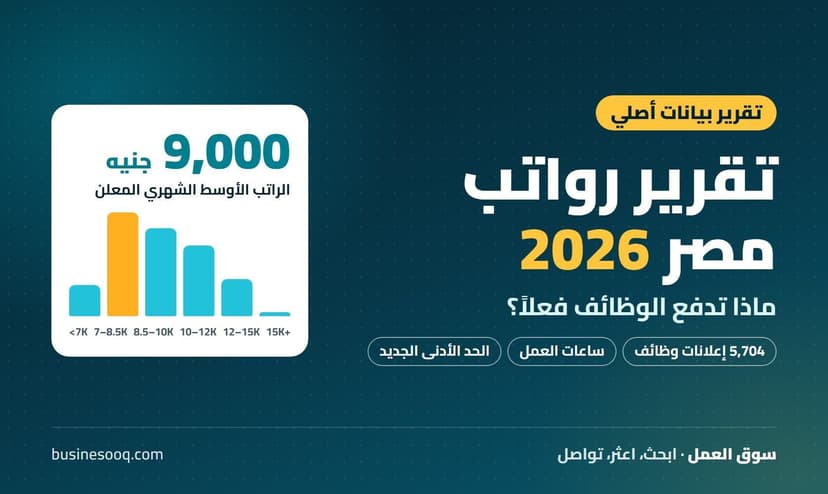
Egypt Salary Report 2026: What 5,704 Job Ads Reveal About Real Pay, 12-Hour Shifts and the New Minimum Wage
Original data report · Published November 2026 · By the BusineSooq team What do jobs in Egypt actually pay? Not what the broad averages say, but what employers themselves write in their ads. We analysed 5,704 job ads published on BusineSooq during 2026. The median advertised salary is EGP 9,000 a month (about USD 167), the 12-hour shift is the rule and not the exception, and a third of ads sit below the new minimum wage that takes effect in Janu
Read Blog